
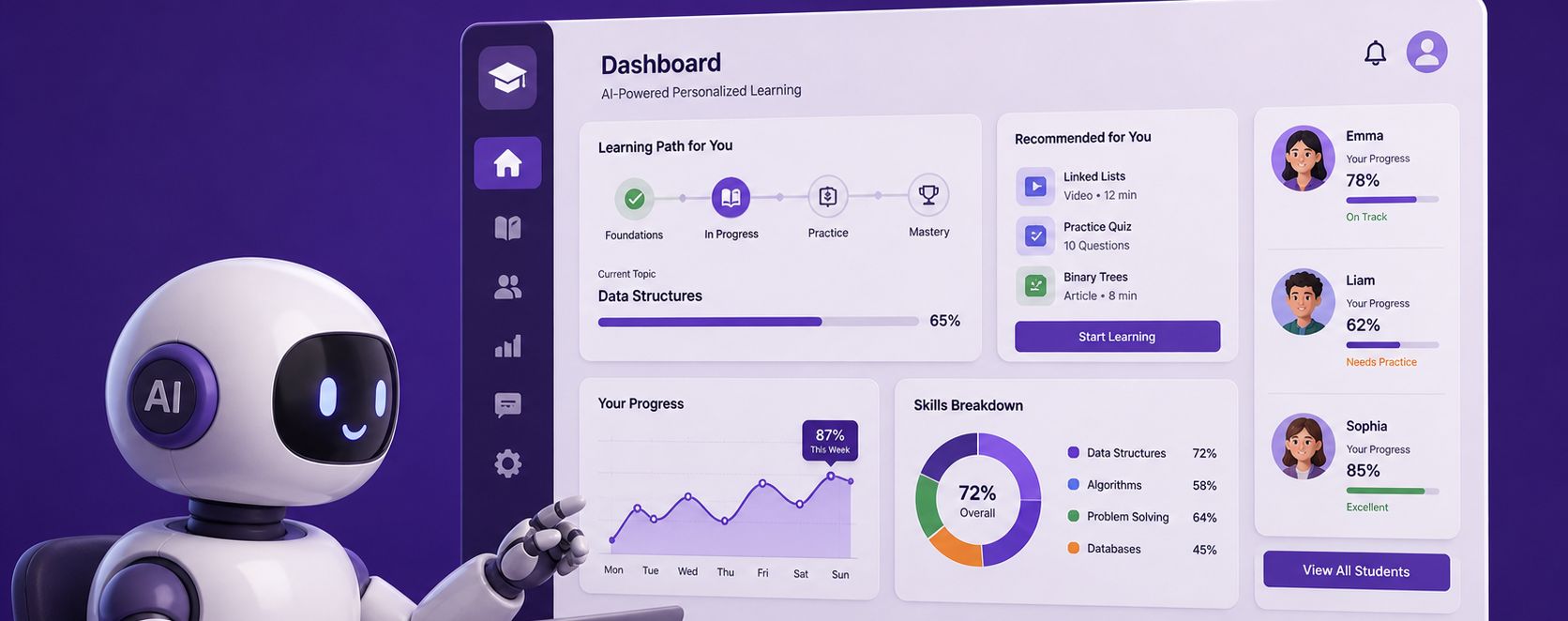
Artificial Intelligence in Personalized Learning: Transforming Education at Scale
- Introduction
- What Is AI-Powered Personalized Learning
- How AI Enables Personalized Learning
- Key Benefits of AI in Personalized Learning
- Challenges and Considerations
- Conclusion
Personalized learning has become a key priority in modern education as institutions seek to address diverse student needs and learning styles [1]. Traditional one-size-fits-all approaches often fail to accommodate individual differences in pace, ability, and preferences [1]. As a result, educators and organizations are turning to artificial intelligence to create more adaptive and tailored learning experiences [2].
Artificial intelligence enables systems to analyze large amounts of learner data and adjust content delivery in real time based on individual performance and behavior [2]. This capability allows education platforms to provide customized learning paths that align with each student’s strengths and weaknesses [2]. As AI technologies continue to evolve, they are playing an increasingly important role in making personalized learning scalable and effective across different educational settings [3].
AI-powered personalized learning refers to the use of artificial intelligence technologies to customize educational content, pacing, and delivery for individual learners [2]. These systems rely on data such as student interactions, assessment results, and engagement patterns to understand how each learner progresses [2]. Based on this analysis, AI can recommend specific materials, adjust difficulty levels, and provide targeted feedback to improve learning outcomes [2].
This approach shifts the focus from standardized instruction to learner-centric education, where each student receives support tailored to their needs [1]. By continuously learning from user behavior, AI systems become more accurate in predicting what content will be most effective for each individual [2]. This creates a dynamic learning environment that evolves alongside the learner [2].
AI enables personalized learning through several core capabilities that enhance both teaching and learning experiences [2]. One of the primary functions is adaptive learning, where systems automatically adjust content difficulty based on student performance [2]. This ensures that learners are neither overwhelmed by complex material nor disengaged by content that is too easy [2].
Another important capability is intelligent recommendation systems, which suggest relevant learning materials based on user preferences and past activity [2]. These recommendations help learners focus on areas that require improvement while reinforcing existing knowledge [2]. As a result, students can progress more efficiently through their learning journey [2].
AI also supports real-time feedback, allowing learners to receive immediate insights into their performance [2]. This instant feedback helps students understand mistakes and correct them quickly, improving knowledge retention [2]. In addition, educators can use AI-generated insights to identify learning gaps and provide targeted support where needed [1].
One of the most significant benefits of AI in personalized learning is improved learning outcomes [3]. Studies show that AI-driven systems can deliver tailored instruction at scale, helping students achieve better academic performance compared to traditional methods [3]. By aligning content with individual needs, AI ensures that learners remain engaged and motivated throughout the process [2].
Another major advantage is scalability, as AI allows personalized learning to be implemented across large groups of students without requiring proportional increases in teaching resources [3]. This makes it possible for institutions to provide high-quality, individualized education to a broader audience [3]. As a result, educational organizations can improve accessibility while maintaining efficiency [3].
AI also enhances efficiency for educators by automating routine tasks such as grading, content recommendations, and performance tracking [2]. This reduces administrative workload and allows teachers to focus on more meaningful interactions with students [2]. By providing actionable insights, AI empowers educators to make data-driven decisions that improve teaching strategies [1].
In addition, personalized learning supported by AI helps build learner confidence by allowing students to progress at their own pace [2]. When learners experience consistent progress and receive tailored support, they are more likely to stay engaged and develop a positive attitude toward learning [2]. This contributes to long-term educational success and skill development [2].
Despite its benefits, implementing AI in personalized learning comes with several challenges that organizations must address [1]. One key concern is data privacy, as AI systems rely on large volumes of student data to function effectively [1]. Ensuring that this data is collected, stored, and used responsibly is critical to maintaining trust and compliance with regulations [1].
Another challenge is the need for high-quality data, as inaccurate or incomplete data can lead to ineffective recommendations and learning outcomes [2]. Organizations must invest in robust data management practices to ensure that AI systems operate reliably [2]. Without proper data infrastructure, the effectiveness of personalized learning solutions may be limited [2].
There is also a need to balance AI automation with human interaction in the learning process [1]. While AI can enhance efficiency and personalization, human educators play a crucial role in providing emotional support, mentorship, and contextual understanding [1]. Combining AI capabilities with human expertise is essential for creating a well-rounded educational experience [1].
Artificial intelligence is transforming personalized learning by enabling adaptive, data-driven, and scalable education solutions [2]. Through capabilities such as real-time feedback, intelligent recommendations, and adaptive content delivery, AI enhances both learning outcomes and teaching efficiency [2]. These advancements make it possible to provide individualized education experiences at a scale that was previously unattainable [3].
While challenges such as data privacy and system implementation remain, the benefits of AI in personalized learning are significant and continue to grow [1]. By combining AI technologies with human expertise, organizations can create more effective and engaging learning environments [1]. As education continues to evolve, AI will play a central role in delivering personalized learning experiences that meet the diverse needs of learners worldwide [3].
Notes and References
- Everett, A. F. (2026). Using Artificial Intelligence to Optimize Personalized Learning - KnowledgeWorks. https://knowledgeworks.org/resources/artificial-intelligence-optimize-personalized-learning/
- Claned. (2024). AThe Role of AI in Personalized Learning - Claned. https://claned.com/the-role-of-ai-in-personalized-learning/
- Kelly, M. (2025). AI Can Deliver Personalized Learning at Scale, Study Shows - Dartmouth College. https://home.dartmouth.edu/news/2025/11/ai-can-deliver-personalized-learning-scale-study-shows


