
Beyond the Museum Wall: Augmented Reality's Role in Cultural Heritage
- Understanding Augmented Reality and Its Growing Influence
- The Essential Role of AR in Cultural Heritage
- Examples of AR in Action
- The National Museum of Singapore
- Microsoft and the Kyoto National Museum
- Conclusion
- Boboc, G. R., et. all (2022, Jul 11). Augmented Reality in Cultural Heritage: An Overview of the Last Decade of Applications - Appl. Sci. https://www.mdpi.com/2076-3417/12/19/9859
- Charr, M. (2020, May). What Can Augmented Reality Do to Bring Heritage to Life? - MuseumNext. https://www.museumnext.com/article/what-can-ar-do-to-bring-heritage-sites-to-life/
- Chen, Y., et. all (2024, April). Why People Use Augmented Reality In Heritage Museums: A Socio-Technical Perspective - Nature. https://www.nature.com/articles/s40494-024-01217-1
Augmented Reality (AR) has rapidly moved from being a novelty to becoming a powerful tool across industries. AR overlays digital elements onto the physical world, creating interactive experiences that enhance how we learn, work, and connect. In education, it turns textbooks into interactive lessons; in healthcare, it assists surgeons with visual overlays during procedures; in retail, it allows customers to preview products before buying. These applications highlight AR’s ability to transform traditional experiences into immersive and engaging ones.
As AR technology grows more accessible, its role extends beyond business and entertainment. One of the most compelling uses of AR lies in cultural preservation and heritage. Museums and heritage sites worldwide are using AR not just to display artifacts, but to tell stories, reconstruct lost environments, and strengthen cultural connections. In this sense, AR is not only reshaping industries but also helping societies safeguard and celebrate their history [1].
Cultural heritage represents more than the preservation of objects. It embodies stories, traditions, and collective memory. Traditionally, museums and heritage sites rely on static displays and written descriptions to convey these narratives. While valuable, such methods often leave gaps in understanding and engagement. AR has emerged as a transformative tool to close those gaps.
With AR, visitors are no longer passive observers. They can walk through ruins and see reconstructions of how temples or palaces once appeared centuries ago. A single artifact can be enriched with layers of information that appear on a smartphone or tablet screen, such as animations of its use in daily life or narratives about its cultural significance. This interactive approach makes learning more dynamic, engaging both casual visitors and academic researchers [1].
Equally important is the role of AR in creating emotional connections. By blending digital stories with physical artifacts, museums can create moments that resonate deeply with visitors. For example, an ancient vase is no longer just pottery on display; AR can project how it was crafted, who used it, and what role it played in ceremonies. These experiences make heritage more relatable, especially for younger generations accustomed to digital interactivity.
AR also helps solve the problem of accessibility. Not everyone can travel to world-renowned sites or handle fragile objects. AR allows these treasures to be shared globally in digital form, enabling virtual access to collections that may otherwise remain hidden in archives. In doing so, it democratizes cultural heritage, making it possible for schools, communities, and even individuals at home to engage with history on their own terms [2].
Researchers emphasize that AR does more than entertain. Studies show that AR supports deeper learning and memory retention. By presenting heritage in an immersive, multisensory way, AR bridges the gap between education and experience. It also fosters inclusivity by offering multilingual content, captions, and accessibility options for visitors with different needs [3].
Finally, AR offers museums flexibility in storytelling. Curators can design multiple narratives around the same exhibit, tailoring experiences for children, scholars, or general audiences. This adaptability ensures that cultural heritage speaks to diverse groups, strengthening its relevance in a rapidly changing digital society. In short, AR is not simply an add-on to exhibitions; it is becoming an essential instrument in how heritage is communicated, preserved, and reimagined.
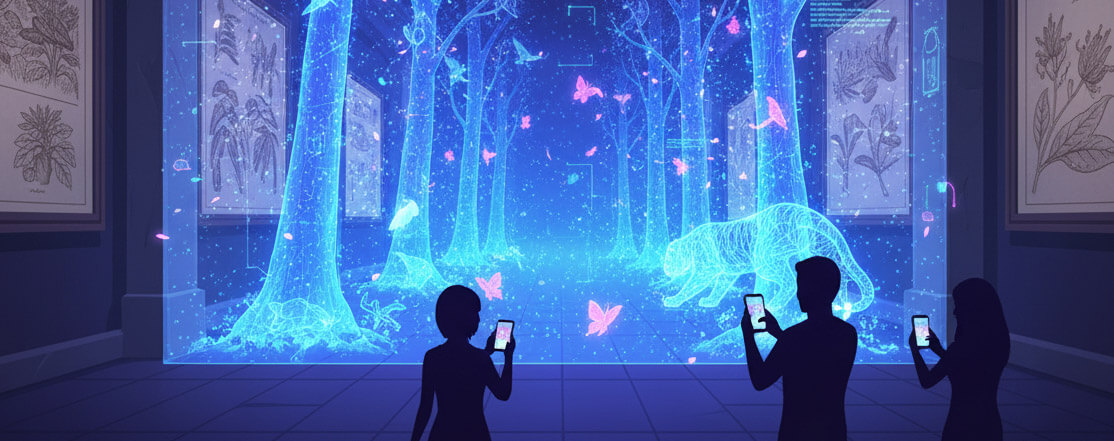
One of the most celebrated examples of AR in heritage is the Story of the Forest exhibit at the National Museum of Singapore. This installation transformed 69 drawings from the William Farquhar Collection of Natural History into interactive digital animations. Visitors could use their smartphones to explore these artworks in detail, walking through an immersive forest filled with animated flora and fauna. The result was an exhibit that not only preserved historical drawings but also reimagined them as living, breathing experiences [1].
Another groundbreaking example comes from Japan, where Microsoft collaborated with the Kyoto National Museum to showcase artifacts from Kennin-ji, the oldest Zen temple in Kyoto. Using HoloLens headsets, visitors were able to view 400-year-old artworks in their original architectural context. Digital projections filled walls and ceilings, recreating the temple’s historic atmosphere. A holographic Zen monk guided visitors through the exhibit, blending narrative with technology. This partnership highlighted how AR can remove the boundaries of physical space, allowing museums to create experiences that extend beyond their walls while still honoring cultural authenticity [1].
Augmented Reality is redefining how cultural heritage is experienced. By transforming static artifacts into interactive stories and opening access to global audiences, AR ensures that history remains engaging and relevant. The examples from Singapore and Kyoto show that AR can both preserve the past and inspire the future. As technology advances, AR will play an even greater role in helping us experience heritage beyond the museum wall.


