
Building the Future Digital Workforce with Google Gemini Agent
- Introduction
- The Evolution from Chat Assistants to Autonomous Digital Colleagues
- Deep Integration Across Enterprise Ecosystems and Multi-Agent Systems
- Enterprise-Grade Governance, Multi-Model Routing, and Cost Control
- Conclusion
The enterprise landscape is undergoing a profound transformation as artificial intelligence evolves from passive chat assistants into fully autonomous digital workers. At the recent Gemini at Work event, Google Cloud unveiled its universal Gemini agent, marking a pivotal shift in how organizations execute complex workflows [1]. Rather than requiring step-by-step instructions for simple tasks, this new class of enterprise AI operates on high-level objectives, planning and executing multi-step business processes independently [1]. According to Alphabet CEO Sundar Pichai, enterprise adoption is accelerating rapidly, with nearly 80 percent of Google Cloud customers actively using AI products and almost 500 enterprise customers processing over 1 trillion tokens each over the past year [1]. For corporate decision-makers, this evolution represents an opportunity to integrate intelligent digital teammates directly into core operational systems to drive speed, efficiency, and continuous innovation.

Traditional enterprise AI tools have largely functioned as reactive chatbots that generate text or answer isolated questions based on immediate user prompts. In contrast, the universal Gemini agent functions as an autonomous colleague capable of managing entire workstreams from start to finish. As highlighted by Google Cloud CEO Thomas Kurian, executives can now delegate an outcome rather than delivering continuous micro-instructions, allowing employees to return to completed assignments [1].
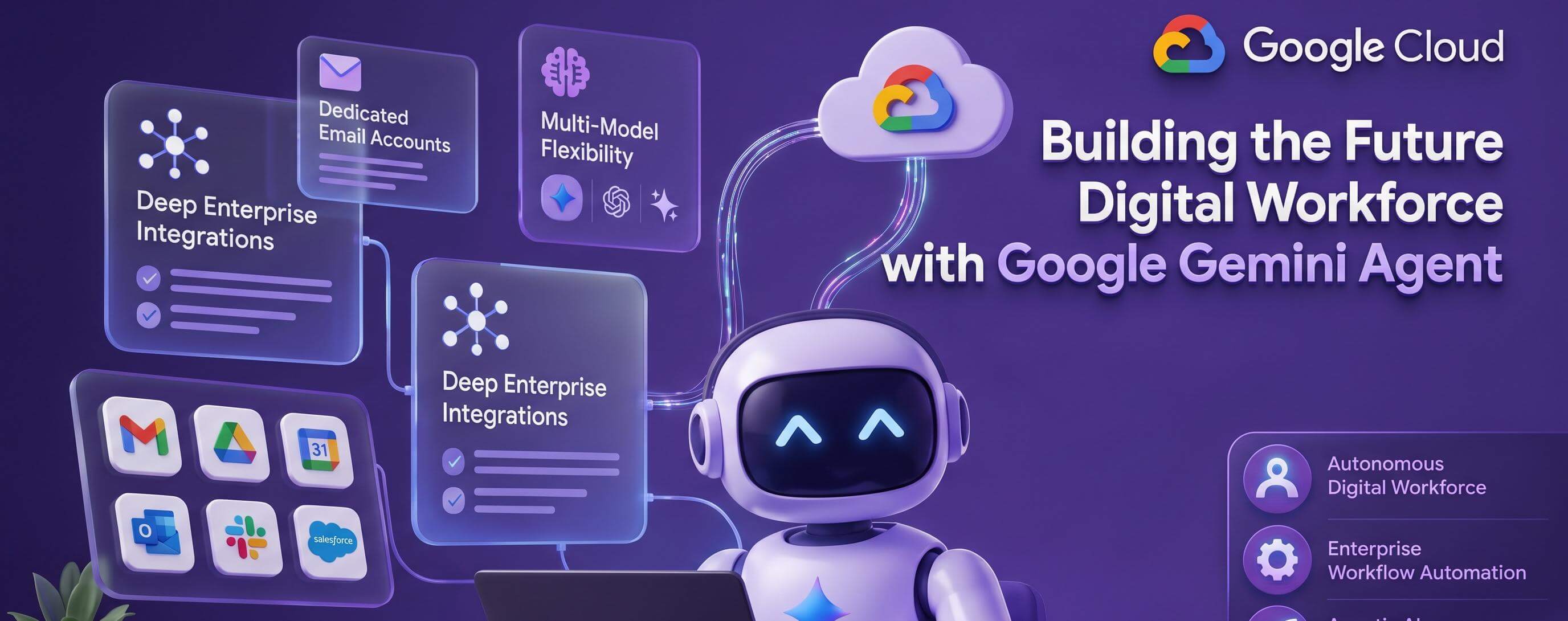
A key differentiator of this architecture is that the AI agent can be assigned its own dedicated Google Workspace account and corporate email address. This identity enables the agent to understand organizational context, including reporting structures, team memberships, time zones, approval hierarchies, and meeting calendar. Employees can seamlessly interact with their digital colleague by sending emails, sharing documents, tagging it in project channels, or inviting it to group chat sessions [3]. Early adopters across diverse global industries, including sportswear brand On, e-commerce leader Shopify, and digital payments provider PayPal, have already begun testing these capabilities to streamline business operations [3].

For autonomous AI to deliver meaningful business value, it must connect directly to the existing software stack without creating isolated data silos. The Gemini agent addresses this challenge by integrating across widespread productivity suites, including Google Workspace tools such as Gmail, Drive, Docs, Sheets, Slides, and Calendar, as well as third-party collaboration platforms like Microsoft 365 and Slack [2]. Furthermore, it links into enterprise systems of record, including Salesforce, ServiceNow, Confluence, Jira, Snowflake, Databricks, BigQuery, and PostgreSQL [3].
To handle sophisticated multi-stage tasks, the system can dynamically deploy a network of temporary sub-agents. These sub-agents work in parallel or sequentially on specialized components of an assignment before synthesizing the final output. Operable across web interfaces, desktop software, mobile devices on iOS and Android, and command-line environments, the agent continues running complex operations in the cloud for hours or days even after an employee steps away from their desk [2].

As major technology providers like Meta and OpenAI launch autonomous agent frameworks, enterprise leaders must prioritize security, governance, and financial control. Google Cloud addresses these requirements by building governance directly into the platform architecture [1]. A dedicated Task Inbox provides complete operational transparency, displaying sub-agent delegations, execution code, and progress updates. Comprehensive audit logs explicitly mark the agent as the executing entity, ensuring accountability across corporate workflows [3].
Financial predictability is maintained through intelligent model routing and cost controls. While the system automatically selects optimal models for specific tasks, organizations can manually configure model choices, incorporating both Google's Gemini models and third-party models such as Anthropic's Claude. Administrators can implement spend caps, set project-level budget constraints, and maintain visibility into department-level usage [1]. These governance controls arrive as Google Cloud solidifies its role as an enterprise technology pillar, posting Q2 revenue of $24.8 billion, representing an 82 percent year-over-year increase, alongside a corporate backlog of $514 billion [3].

The launch of universal enterprise agents marks a milestone in the transition toward autonomous digital workforces. With specialized industry solutions currently in preview for financial services and legal sectors, and future editions planned for government, healthcare, and retail, AI implementation is moving rapidly into tailored industry workflows. By combining digital identities, broad system connectivity, flexible multi-model orchestration, and enterprise governance, organizations can empower human teams to focus on strategy and creativity while digital colleagues manage complex execution. As cloud adoption accelerates toward an estimated $2 trillion market by 2030, business leaders who embrace objective-driven AI will establish a strong competitive advantage in organizational agility and operational excellence.
Notes and References
- Dignan, L. (2026). Google Cloud Launches Gemini Agent to Work Across Enterprise Systems - Constellation Research. https://www.constellationr.com/insights/news/google-cloud-launches-gemini-agent-work-across-enterprise-systems
- BigGo Finance. (2026). Google Unveils Enterprise Gemini Agent—'An AI Colleague with Its Own Email Account' - BigGo Finance. https://finance.biggo.com/news/7b42b30a-2d29-473b-85f0-8a63f8bc22eb
- Quasim, R. (2026). Google Launches Gemini Agent as AI Giants Race to Build Autonomous Workers - The American Bazaar. https://americanbazaaronline.com/2026/10/08/google-launches-gemini-agent-as-ai-giants-race-to-build-autonomous-workers-489653/


