
Enhancing Clinical Readiness Through Virtual Reality in Dentistry
- Introduction
- Limitations of Traditional Dental Training
- How Virtual Simulation Transform Dental Education
- Enhancing Clinical Skills and Confidence
- Case Studies: Real-World Applications of VR in Dental Education
- Operational and Institutional Benefits
- Conclusion
Dental education is undergoing a significant transformation as institutions seek more effective and scalable ways to train future professionals [1]. Traditional teaching methods, which rely heavily on lectures, textbooks, and limited hands-on practice, often struggle to fully prepare students for the complexity of real clinical environments [1]. As patient expectations rise and procedures become more advanced, there is a growing need for innovative training tools that can bridge the gap between theory and practice [2]. Virtual reality (VR) simulators have emerged as a promising solution, offering immersive and controlled learning environments that enhance skill development and clinical readiness [3].
Conventional dental education typically involves preclinical training using mannequins followed by supervised clinical practice on real patients [1]. While this approach provides foundational knowledge, it presents several limitations, particularly in terms of consistency and accessibility [1]. Students often face restricted opportunities to practice complex procedures due to limited patient availability and variability in case exposure [2].
Additionally, the learning experience can be highly subjective, as feedback depends on instructor observation and may vary between educators [1]. This inconsistency can lead to gaps in competency development and reduced confidence among students [2]. There is also an inherent risk when transitioning from simulation to real patient care, as students may not feel adequately prepared to handle unexpected complications [3]. These challenges highlight the need for more standardized, repeatable, and safe training methods.
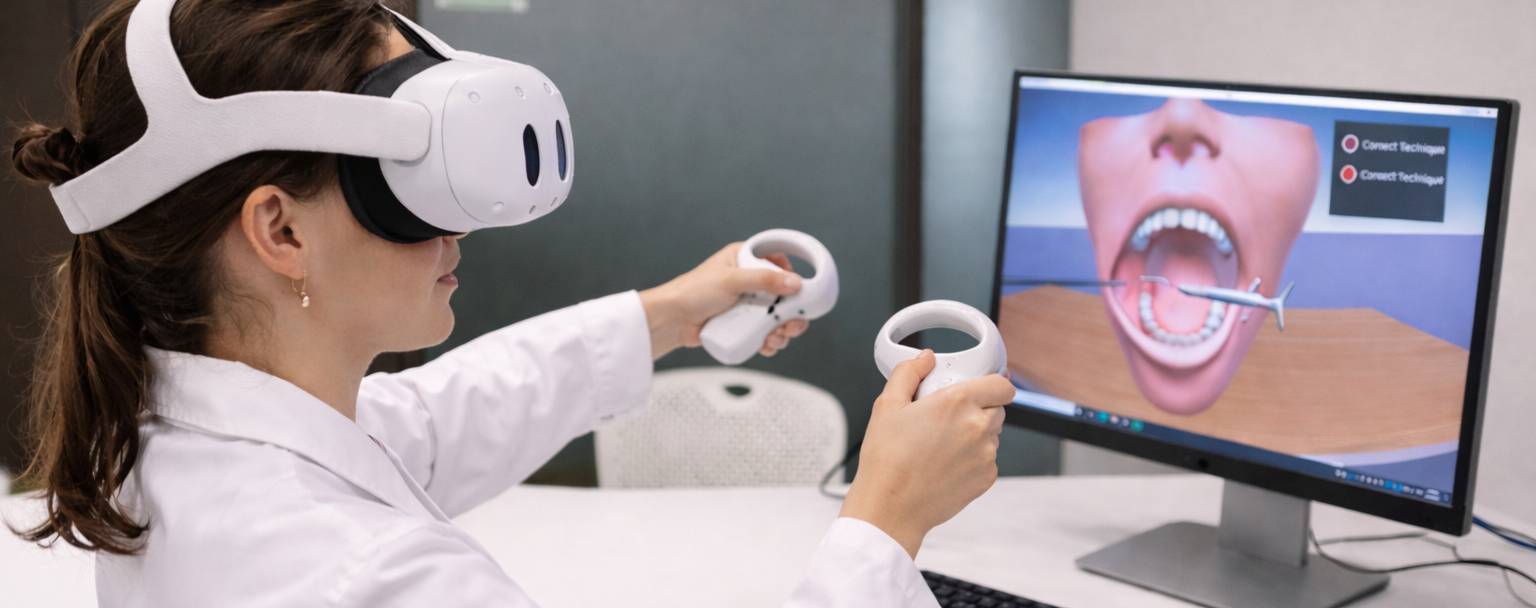
Virtual reality simulation introduce a new paradigm in dental training by creating immersive, interactive environments where students can practice procedures without real-world consequences [3]. These systems replicate clinical scenarios using advanced graphics, haptic feedback, and real-time performance tracking, allowing learners to develop both technical and decision-making skills [2].
One of the key advantages of VR simulators is the ability to provide immediate, objective feedback based on predefined metrics [1]. This enables students to identify mistakes, refine techniques, and track progress over time in a structured manner [2]. Unlike traditional methods, VR training can be repeated indefinitely, ensuring that students achieve proficiency before advancing to real patient interactions [3].
Furthermore, VR simulators support personalized learning experiences by adapting to individual skill levels and learning speeds [2]. This flexibility helps address the diverse needs of students while maintaining consistent educational standards across institutions [1].
Developing clinical competence requires more than theoretical understanding, as it involves precision, hand-eye coordination, and decision-making under pressure [1]. Virtual reality simulators provide a risk-free environment where students can practice these skills repeatedly until they reach a high level of accuracy and confidence [3].
Research indicates that simulation-based training can improve procedural accuracy and reduce errors in clinical settings [2]. By exposing students to a wide range of scenarios, including rare or complex cases, VR systems help build a deeper understanding of dental procedures and patient management [1]. This comprehensive exposure is often difficult to achieve through traditional training alone due to limited case diversity [2].
In addition, the immersive nature of VR enhances engagement and knowledge retention, making the learning process more effective and enjoyable [3]. Students are more likely to remain focused and motivated when interacting with realistic simulations compared to passive learning methods [2].
Several institutions have already begun integrating virtual reality simulators into their dental programs, demonstrating measurable improvements in student performance and learning outcomes [1]. For example, studies have shown that students trained with VR systems perform better in preclinical assessments compared to those using conventional methods alone [1].
Another case highlights the use of haptic-enabled VR simulators, which allow students to feel tactile feedback while performing procedures such as cavity preparation [3]. This technology enhances the realism of the training experience and helps students develop the fine motor skills required for clinical practice [3].
In addition, VR-based training has been used to standardize assessments by providing consistent evaluation criteria across all learners [2]. This approach reduces subjectivity and ensures that all students meet the same competency benchmarks before progressing to patient care [2].
These examples demonstrate how VR simulators can complement traditional education methods while addressing their limitations, ultimately leading to more competent and confident dental professionals [1].
Beyond improving student learning, virtual reality simulators offer significant benefits for educational institutions and training providers [2]. One of the primary advantages is scalability, as VR systems can accommodate multiple users and provide consistent training experiences without the need for additional physical resources [1].
Cost efficiency is another important factor, as VR reduces the reliance on consumables such as dental materials and equipment used in traditional simulation labs [2]. Over time, this can lead to substantial savings while maintaining high-quality training standards [1].
Moreover, VR simulators enable remote learning and collaboration, allowing students to access training modules from different locations [3]. This capability is particularly valuable in situations where access to physical facilities is limited, ensuring continuity in education and skill development [2].
The increasing complexity of dental procedures and the limitations of traditional training methods make it essential for educational institutions to adopt more advanced learning solutions [1]. Virtual reality simulators address these challenges by providing immersive, repeatable, and data-driven training environments that enhance both technical skills and clinical confidence [2].
By integrating VR into dental education, institutions can deliver more consistent and effective training while preparing students for the demands of modern healthcare [3]. As adoption continues to grow, virtual reality is set to become a cornerstone of dental education, shaping the future of how dental professionals are trained and developed [1].
Notes and References
- Roy, E., et. al. (2017). The Need For Virtual Reality Simulators In Dental Education: A Review - The Saudi Dental Journal. https://pmc.ncbi.nlm.nih.gov/articles/PMC5411891/
- Penumarti, Y., et. al. (2026). Evaluating The Efficacy Of Toothy Vr: A Virtual Reality Simulation For Dental Implant Training - Digital Dentistry Journal. https://www.sciencedirect.com/science/article/pii/S2950643326000103
- Algarni, Y., et. al. (2024). The Impact Of Virtual Reality Simulation On Dental Education: A Systematic Review Of Learning Outcomes And Student Engagement - Journal of Dental Education. https://onlinelibrary.wiley.com/doi/abs/10.1002/jdd.13619


