
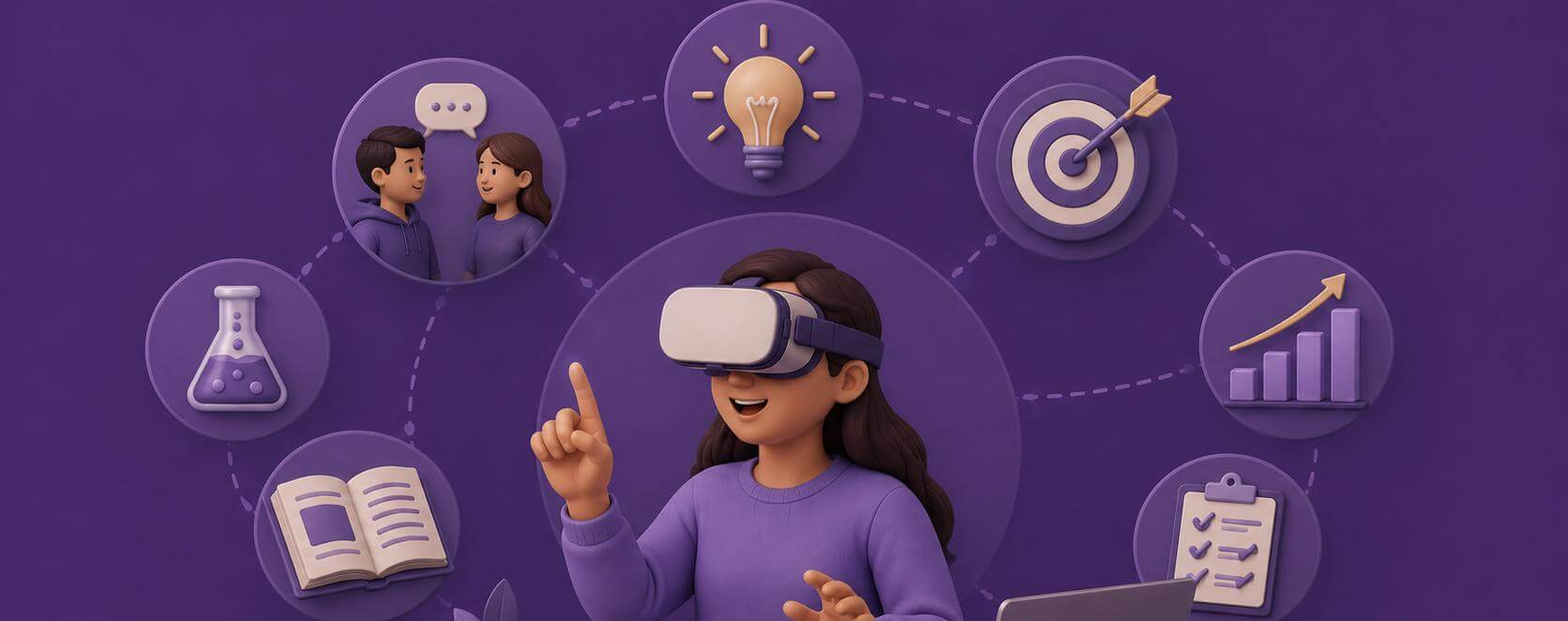
The Impact of Interactive & Immersive Learning on Student Outcomes
- Introduction
- The Role of Immersive Learning in Modern Education
- Impact on Cognitive Development
- Impact on Affective and Behavioral Aspects
- Enhancing Engagement and Learning Experience
- Challenges and Considerations
- Conclusion
Interactive and immersive learning is transforming how students engage with educational content in the digital era [1]. Powered by technologies such as virtual reality (VR), augmented reality (AR), and mixed reality, this approach creates simulated environments where students actively participate rather than passively receive information [2].This shift is increasingly important as traditional teaching methods often fail to equip students with the practical skills and critical thinking required in today’s complex world [2].
Immersive learning blends physical and digital experiences to create interactive environments that support exploration, experimentation, and collaboration [3]. As a result, it is becoming a key strategy for improving both learning outcomes and student engagement across education systems [1].
Immersive learning plays a critical role in redefining how knowledge is delivered and experienced [1]. Unlike traditional methods that rely on lectures and textbooks, immersive learning positions students at the center of the learning process through interactive and experiential environments [1].These environments enable learners to explore scenarios that are difficult or impossible to access in real life, such as complex scientific processes or technical simulations [1]. This expands educational possibilities by removing physical limitations and making learning more accessible and flexible [1].
In addition, immersive learning supports online and blended learning models, which have become increasingly relevant in recent years [1]. Technology acts as a complement to educators rather than a replacement, allowing for a more effective integration of digital tools and traditional teaching practices [1].
One of the most significant advantages of immersive learning is its impact on students’ cognitive development [1]. Research shows that immersive environments can improve conceptual understanding and enhance academic performance [1]. Through realistic simulations, students can better visualize abstract concepts and gain deeper insights into complex topics [1]. This is particularly beneficial in fields that require practical application, such as science, engineering, and healthcare [2].
Immersive learning also promotes inquiry-based learning, where students actively explore problems and develop solutions [1]. This process strengthens critical thinking and problem-solving skills, which are essential competencies for the modern workforce [2]. Additionally, immersive environments help bridge the gap between theoretical knowledge and real-world application [2].Students can design, test, and validate solutions in virtual settings, allowing them to apply their knowledge in a safe and controlled environment [2].
Immersive learning also enhances technological competencies by enabling students to interact with digital tools and platforms [2]. These experiences prepare learners for future careers that require digital literacy, innovation, and adaptability [2].
Beyond cognitive benefits, immersive learning has a strong influence on students’ motivation and behavior [1]. Studies show that immersive experiences can increase engagement, motivation, and positive attitudes toward learning [1]. Students often feel more connected to the subject matter, which enhances their interest and willingness to learn [1].
Immersive learning also strengthens self-efficacy, as students gain confidence in their ability to understand and apply knowledge [1]. By successfully completing tasks in virtual environments, learners develop a sense of achievement that reinforces their learning process [1]. In addition, immersive environments encourage collaboration and communication among students [1]. Many immersive experiences involve teamwork, allowing learners to exchange ideas and solve problems collectively [1]. Another important benefit is the development of empathy and awareness, particularly in simulations that replicate real-world issues [1]. These experiences help students understand different perspectives and build deeper connections to the topics being studied [1].
Engagement is a key driver of effective learning, and immersive technologies significantly enhance this aspect [3]. By incorporating interactive elements such as 3D visuals, simulations, and real-time feedback, immersive learning creates a more dynamic and engaging experience [2]. Students are more likely to stay focused and actively participate when learning is interactive and experiential [3]. This increased engagement leads to higher satisfaction and improved academic performance [3].
Immersive learning also enables more personalized learning experiences by adapting to individual needs and learning styles [2]. This flexibility allows educators to design tailored learning pathways that maximize student potential [2].
Furthermore, immersive environments provide immediate feedback, helping students identify mistakes and improve their understanding in real time [2]. This continuous feedback loop supports self-directed learning and long-term knowledge retention [2].
Despite its benefits, immersive learning presents several challenges that must be addressed [2]. One major limitation is the cost of implementing advanced technologies such as VR and AR, which can restrict access for some institutions [2]. Technical issues, including connectivity and device requirements, can also impact the effectiveness of immersive learning experiences [1]. In addition, educators may require training to effectively integrate these technologies into their teaching practices [2].
Another concern is the risk of cognitive overload when students interact with complex virtual environments without proper guidance [2]. To ensure effectiveness, immersive learning must be carefully designed and supported by appropriate instructional strategies [2].
Interactive and immersive learning represents a significant advancement in education, offering a more engaging and effective approach to teaching and learning [1]. By combining advanced technologies with student-centered methods, it enhances both cognitive and emotional aspects of learning [1]. From improving understanding and problem-solving skills to increasing motivation and engagement, immersive learning addresses many limitations of traditional education [2]. However, successful implementation requires careful planning, adequate resources, and ongoing support for educators [2]. As education continues to evolve, immersive learning will play a crucial role in preparing students for the demands of a rapidly changing and technology-driven world [3].
Notes and References
- Soelistya, D., et al. (2023). The Effect of Immersive Learning on Students' Cognitive and Affective Aspects - Redfame Publishing Inc. https://redfame.com/journal/index.php/smc/article/view/6072
- Mamani-Choque, M. Y., et al. (2025). Impact of Immersive Learning Environments on the Development of Technological Competencies in Students - International Journal of Evaluation and Research in Education. https://ijere.iaescore.com/index.php/IJERE/article/view/33034
- Nastiti, K. A., et al. (2024). The Effect of Immersive Technology on Enhancing Student Learning: A Systematic Literature Review - JITK. https://ejournal.nusamandiri.ac.id/index.php/jitk/article/view/4775


