
Transforming Maritime Training with VR-based Simulation
- Introduction
- The Shift Toward Simulation-Based Maritime Training
- Essential Features of Effective VR Maritime Training Solutions
- Realistic Simulation Environments
- Scenario-Based Training Modules
- Interactive Equipment and Controls
- Performance Tracking and Assessment
- Multi-User and Collaborative Training
- Continuous Scenario Updates
- Conclusion
The maritime industry operates in a complex, high-risk environment where safety, efficiency, and fast decision making are essential for successful voyages [1]. Seafarers must be prepared to handle situations such as equipment failures and severe weather while maintaining strict safety standards at sea [1]. As vessels become more technologically advanced, training methods must evolve to prepare crews for increasingly complex operations [1]. Traditional classroom learning and onboard mentoring remain important, but they are limited in their ability to safely replicate high-risk or rare scenarios.
Virtual Reality is emerging as a powerful tool for maritime training through immersive simulation environments [1]. VR places trainees inside realistic digital ship environments where they can practice procedures, decision making, and emergency responses without real-world risks [2]. These simulations can recreate ship bridges, engine rooms, and emergency situations with high accuracy, giving trainees practical experience before facing similar challenges at sea [2]. As a result, simulation technologies are becoming an important part of modern maritime training strategies designed to prepare crews for real operational conditions [1].
The maritime industry is undergoing a transformation in how seafarers are trained, driven by increasing regulatory requirements, evolving vessel technologies, and the need for improved safety outcomes. Modern vessels are equipped with advanced navigation systems, automation tools, and digital technologies that require crews to develop new technical and operational skills. Training programs must therefore evolve to ensure that seafarers are prepared to operate increasingly sophisticated maritime systems [1].
Simulation-based training has become a central element in preparing maritime professionals for real-world operations. Advanced simulation environments allow trainees to experience operational scenarios that would be difficult or dangerous to replicate in real life. These simulations can include collision avoidance exercises, equipment failures, extreme weather conditions, and emergency response procedures. By practicing these scenarios in a controlled environment, seafarers can develop situational awareness and critical decision making skills before encountering similar events during actual voyages [2].
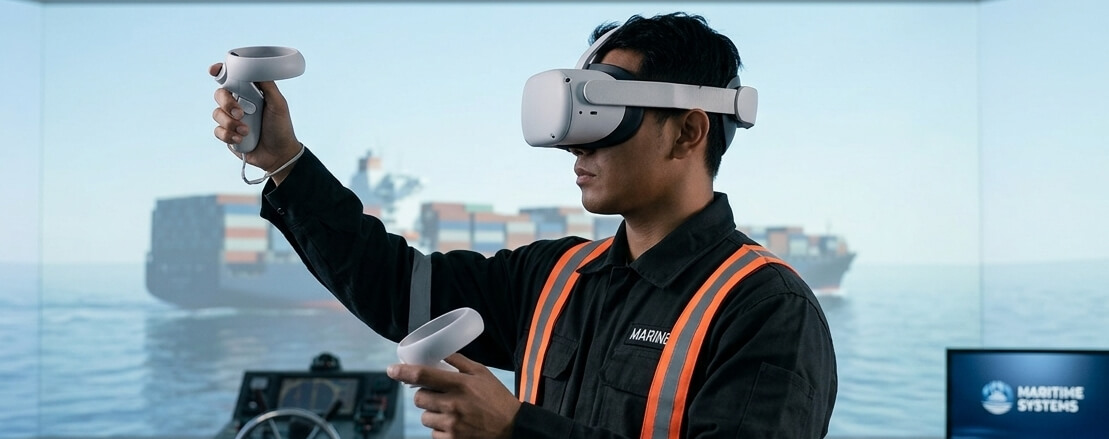
Immersive VR takes this concept further by placing trainees directly inside the simulated environment rather than observing it on a traditional simulator screen. VR headsets and interactive interfaces allow users to interact with virtual ship controls, instruments, and surroundings as if they were physically present on board. This level of immersion enhances engagement and allows trainees to better understand spatial awareness and operational workflows within complex maritime systems [2].
The growing importance of simulation technologies is reflected across multiple sectors, including maritime and defense. Simulation and training technologies are gaining significant investment globally as industries seek safer and more efficient ways to prepare personnel for high-risk operational environments [2].
Effective VR training should accurately replicate ship environments such as bridges, engine rooms, and control panels. Realistic visuals and system behavior help trainees develop skills that translate directly to real maritime operations [2].
VR systems should include structured scenarios that reflect real maritime challenges. Examples include navigation exercises, collision avoidance, emergency evacuations, and equipment failures. Scenario-based learning helps trainees apply procedures in realistic operational contexts [2].
Immersive training should allow users to interact with ship instruments, navigation systems, and operational controls. This hands-on interaction helps trainees understand workflows and become familiar with onboard equipment [2].
Integrated analytics tools enable instructors to monitor trainee actions, response times, and decision making during simulations. These insights help training teams evaluate performance and identify areas for improvement [2].
Maritime operations rely on teamwork and coordinated decision making. VR platforms can support multi-user simulations where trainees work together in shared scenarios. This environment helps teams practice communication and collaborative problem solving [2].
As maritime technologies and regulations evolve, training content must keep pace. VR platforms should allow modules to be updated regularly to reflect current operational standards and industry requirements [2].
As maritime operations become more technologically complex, the need for advanced training solutions continues to grow. Traditional learning methods remain important, but they are often insufficient for preparing seafarers to handle rare or high-risk scenarios that require immediate and precise responses [1].
Virtual Reality provides a powerful immersive training approach that allows maritime professionals to experience realistic operational environments without the risks associated with real-world exercises. Through interactive simulations, trainees can practice navigation, emergency response, and equipment operation in a safe and controlled setting [2].
By integrating realistic environments, scenario-based learning, performance analytics, and collaborative training capabilities, VR solutions offer a comprehensive platform for modern maritime education. These immersive technologies enable organizations to enhance workforce readiness while maintaining high safety standards across maritime operations.
As the maritime industry continues its digital transformation, immersive VR training will play an increasingly important role in equipping seafarers with the skills and confidence needed to navigate the challenges of tomorrow’s seas [1].
Notes and References
- Steliou, V. (2024). Navigating tomorrow’s seas: The Transformative Era of Maritime Training - Safety4Sea. https://safety4sea.com/navigating-tomorrows-seas-the-transformative-era-of-maritime-training/
- Safety4Sea. (2025). DNV: Simulation Is Becoming Central To Preparing Seafarers For Real Operations - Safety4Sea. https://safety4sea.com/dnv-simulation-is-becoming-central-to-preparing-seafarers-for-real-operations/


