
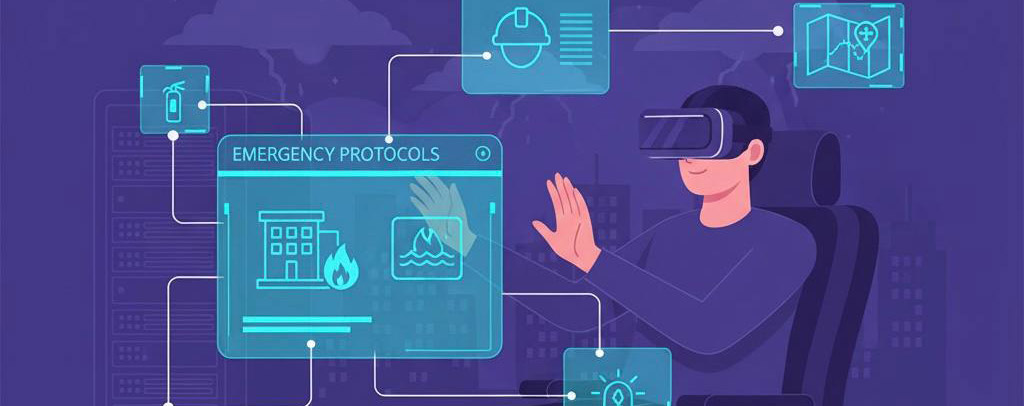
Virtual Reality-Based Disaster Mitigation Education: Immersive Learning for a Safer Future
As natural disasters become more frequent and intense, traditional drills and classroom-based disaster education are no longer enough. Virtual Reality (VR) technology is now stepping in as a transformative tool for disaster mitigation education. By immersing users in lifelike simulations, VR allows people to experience disaster scenarios safely and practice response strategies in a controlled, repeatable way.
- Why Virtual Reality Is Transforming Disaster Education
- How VR Enhances Disaster Mitigation Education
- Experiential Learning: With VR, participants can immerse themselves in a simulated environment where they must make real-time decisions. For instance, users can practice choosing evacuation routes during a flood or managing triage after an explosion [2].
- Emotional Preparedness and Confidence: Research shows that VR helps reduce anxiety and builds mental readiness for high-pressure situations. In one study, students living in disaster-prone areas who used VR simulations reported higher confidence and better understanding of emergency procedures compared to those trained through lectures [1].
- Engagement and Knowledge Retention: Immersive experiences tend to produce higher engagement and stronger retention. The scoping review noted that interactive VR activities were significantly more effective than passive training methods [1].
- Diverse Scenarios and Customization: VR allows trainers to create simulations for different disaster types such as tsunamis, chemical spills, or floods. This flexibility helps adapt training for various audiences, from children to emergency responders.
- Empowering Communities: While many VR programs initially targeted professionals, community-based initiatives are now emerging. For example, public participants in Indonesia could select “survivor” or “rescuer” modes during the VR simulation, making the learning experience inclusive for all ages [2].
- Challenges and Considerations
- Research Gaps: The current body of research remains limited. The scoping review identified only six studies, most focused on professionals rather than the general public. Broader research is needed to evaluate different cultures, age groups, and disaster types [1].
- Cost and Infrastructure: While VR devices are cheaper than before, costs related to hardware, software, and maintenance can still be prohibitive, especially in developing countries.
- Curriculum Integration: VR should complement existing disaster education programs, not replace them. For maximum impact, it must be integrated into school curricula, community workshops, and national preparedness initiatives.
- Accessibility: Ensuring access for diverse communities is vital. Equal exposure to these training tools will help prevent the digital divide from expanding.
- Conclusion
- Kimura, R., et. all. (2024, November 20). Scoping Review of Virtual Reality (VR)-Based Disaster Mitigation Education - Cureus Journal of Medical Science. https://www.cureus.com/articles/314712-scoping-review-of-virtual-reality-vr-based-disaster-mitigation-education#!/
- Muthohar. (2023, January 29). The Thrill of Trying Disaster Virtual Reality Simulator - Dompet Dhuafa. https://www.dompetdhuafa.org/en/the-thrill-of-trying-disaster-virtual-reality-simulator/
- Dechamma, V. (2024, March 24). The Role Technologies in Enhancing Japan’s Disaster Resilience - Jumpstart. https://www.jumpstartmag.com/the-role-of-ai-and-technology-in-enhancing-japans-disaster-resilience/
Virtual Reality is an immersive environment that places users inside a simulated space using headsets or interactive devices. In disaster education, VR provides learners the opportunity to experience events such as earthquakes, floods, or fires as if they were real. This technology allows them to make critical decisions, react under pressure, and learn essential safety behaviors without actual danger.
A recent scoping review found that VR-based disaster mitigation education is an emerging but rapidly growing field. The review examined six empirical studies across regions such as East Asia, North America, and Australia, focusing on scenarios like explosions, fires, and earthquakes. The research revealed that VR is not only feasible but highly effective in preparing both professionals and communities for emergencies [1].
For example, in Tokyo, public facilities now use VR and AR to simulate floods, landslides, and fires. One example is a 3D VR theater where participants make decisions such as which evacuation route to take or how to react to smoke. This immersive approach improves the public’s ability to stay calm and act rationally in real crises [3]. While in Indonesia, Dompet Dhuafa’s Disaster Management Center launched a VR Simulation experience during the Jakarta Humanity Festival. Participants wore headsets and practiced real-time responses to fires and earthquakes [2].
The global rise of VR in disaster education is driven by several factors. First, the increasing risk of climate-related disasters demands new tools to train communities efficiently. Second, VR devices and software have become more accessible and affordable. Finally, unlike conventional drills that are costly and time-consuming, VR simulations are scalable and repeatable, allowing learners to practice as many times as needed.
VR brings several unique advantages to disaster preparedness, including experiential learning, cognitive engagement, and accessibility.
Despite its promise, VR-based disaster mitigation education faces several challenges that must be addressed for wider adoption.
Virtual Reality-based disaster mitigation education is redefining how individuals and communities prepare for emergencies. By simulating realistic crisis scenarios, VR enables learners to build confidence, improve decision-making, and develop life-saving reflexes without real-world risks. Beyond its technological novelty, VR represents a cultural shift in how societies approach disaster readiness. Instead of learning through fear or rote memorization, people can now engage in meaningful, hands-on practice that mirrors real-life experiences. The result is not only better preparedness but also a stronger sense of community resilience.
As the climate crisis continues to intensify, adopting technologies like VR is no longer optional, it is essential. Governments, educators, and humanitarian organizations have a unique opportunity to collaborate in scaling this innovation, ensuring that disaster mitigation becomes as immersive, inclusive, and effective as possible. When technology meets empathy, learning transforms into action. And through Virtual Reality, that action can save lives.


