
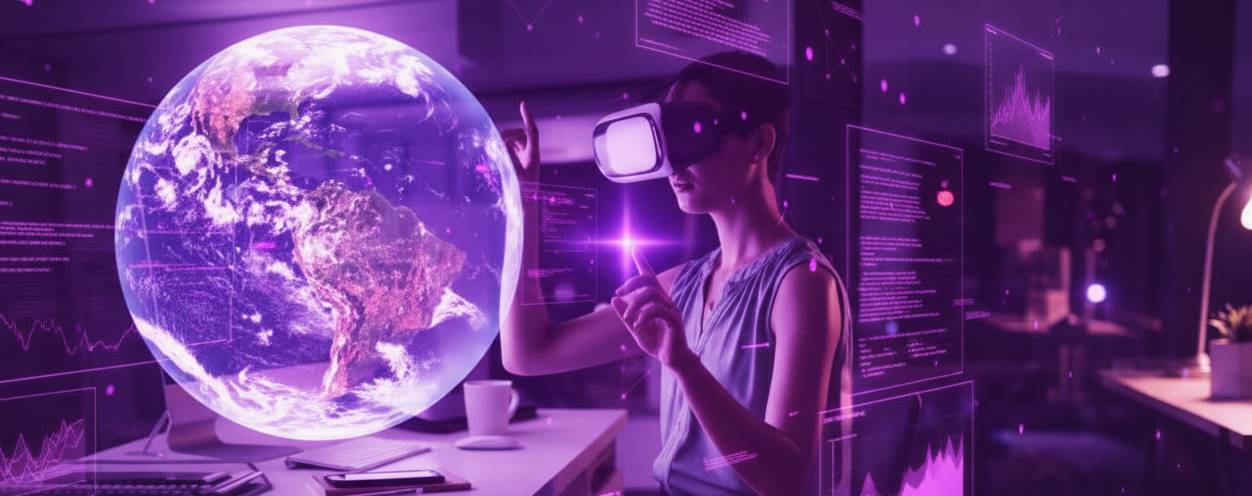
Virtual Reality for the Planet: How Immersive Experiences Inspire Climate Action
Climate change often feels distant, a problem happening somewhere else, to people we will never meet [1]. Virtual Reality is changing that perception by placing users inside realistic climate impacted environments that feel vivid, emotional, and personal [1]. Through immersive storytelling and sensory engagement, VR helps people understand climate risks in a way traditional media cannot [1].
- Why VR Is Transforming Climate Awareness
- VR Boosts Environmental Concern and Action
- Real-Life Applications
- The Power of Immersive Storytelling
- Opportunities and Challenges
- Conclusion
- Jordan, R. (2025, October 24). VR Strengthens Connections To Communities Facing Climate Change - Stanford Report. https://news.stanford.edu/stories/2025/10/virtual-reality-climate-change-communities-research
- Zimmermann, D., Wolf, P., & Kaspar, K. (2025). Virtual Reality Versus Classic Presentations Of Mass Media Campaigns: Effectiveness And Psychological Mechanisms Using The Example Of Environmental Protection - Computers in Human Behavior, 168, 108643. https://www.sciencedirect.com/science/article/pii/S0747563225000901?via%3Dihub
- Aryan. (2025, October 27). Virtual Reality Could Help Those Not Taking Climate Change Seriously - India Today. https://www.verdict.co.uk/digital-twins-cybersecurity-benefit/
Many people struggle to understand climate change because the effects can feel detached from daily life [1]. A Stanford study found that VR helps bridge this psychological distance by allowing users to virtually visit communities experiencing real climate impacts, such as flooding or rising sea levels [1]. Participants could explore these environments while hearing the stories of people who live there, creating a stronger sense of presence and empathy [1].
The researchers found that VR builds what they call constructive emotion, which means it encourages users to feel connected and hopeful rather than fearful or overwhelmed [1]. This emotional connection increases the likelihood that people will support climate policies, participate in environmental programs, or advocate for change [1].
A study from the University of Cologne showed that VR documentaries about nature and the environment significantly increase environmental awareness compared to traditional video formats [2]. Participants reported feeling more immersed in the story and more emotionally connected to the natural world after watching the VR experience [2]. This sense of immersion directly influenced their willingness to adopt more sustainable behaviors [2].
The study also found that VR can improve empathy by allowing viewers to feel as if they are physically present in ecosystems that are threatened by climate change [2]. This emotional closeness increased their motivation to protect the environment and raised their intention to donate to environmental causes [2]. The findings suggest that VR is not only a tool for communication but also a catalyst for action and behavioral change [2].
In India, where extreme weather events are becoming more common, VR is emerging as a tool to help communities better understand climate risks and mitigation strategies [3]. A recent study highlighted the value of VR for educating the public about rising emissions and increasing climate hazards such as floods, heatwaves, and droughts [3]. These immersive experiences make climate impacts feel personal and immediate, especially for people who may not fully grasp the long term consequences of global warming [3].
The study noted that VR can visually demonstrate the connection between emissions, extreme weather, and local vulnerability in a way that text or lectures cannot achieve [3]. By virtually placing users in climate affected environments, VR encourages people to think more critically about their own role in climate solutions and strengthens support for adaptation strategies [3]. This is particularly relevant for young people in India, who represent a major demographic in environmental education efforts [3].
VR is not only an educational tool. It is also a storytelling medium that makes climate narratives more relatable and emotionally engaging [1]. By allowing users to see, hear, and sometimes interact with climate realities, VR delivers a multisensory experience that encourages deeper understanding [1]. Research shows that the more immersed people feel, the more likely they are to support environmental initiatives and contribute to climate solutions [2].
Immersive storytelling transforms passive awareness into active empathy by generating emotional connections with the environment and with communities affected by climate change [1]. This approach is more effective than fear based messages that often leave audiences feeling helpless rather than empowered [1]. VR also offers scalability, making it possible to bring immersive climate education to classrooms, exhibitions, and community programs around the world [1].
R holds enormous potential for climate communication, but several challenges must be addressed. Accessibility remains a major barrier because not everyone has access to VR headsets or the technology required to run immersive content [1]. High quality VR production is also costly and requires expertise in storytelling, design, and climate science to ensure accuracy and impact [2].
Despite these challenges, the opportunities outweigh the limitations. VR can support climate literacy, encourage empathy, and influence behavior across large populations [1]. It can also make complex climate science easier to understand by turning data into lived experiences [3]. As VR becomes more affordable, it is likely to play a growing role in climate education and public awareness campaigns worldwide [1].
Virtual Reality is creating a new frontier for climate awareness by transforming distant scientific concepts into personal and emotional experiences [1]. Research from Stanford, the University of Cologne, and studies in India consistently shows that VR increases understanding, builds empathy, and inspires climate friendly behavior [1][2][3]. The ability to virtually step into climate affected environments helps people grasp the urgency of the crisis and encourages them to take action [1][2][3].
By making the invisible visible, VR brings climate change closer to home and empowers individuals to move from awareness to meaningful engagement [1]. As technology continues to evolve, immersive storytelling may become one of the most powerful tools for mobilizing global climate action [1][2][3].


