
Virtual Reality in Enhancing Rehabilitation Therapy
- Introduction
- How Virtual Reality Works in Rehabilitation
- Applications Across Rehabilitation Fields
- Benefits for Patients and Healthcare Providers
- Clinical Evidence and Emerging Research
- Conclusion
Virtual Reality is increasingly being adopted as a transformative tool in modern rehabilitation by enabling immersive, interactive, and patient-centered therapy experiences [1]. Rehabilitation traditionally relies on repetitive physical exercises that can feel monotonous and mentally exhausting for patients, which often leads to low motivation and reduced adherence to treatment plans [1]. Virtual Reality addresses this challenge by creating engaging digital environments that encourage active participation while supporting therapeutic goals [1]. By combining immersive visuals, real-time feedback, and controlled simulations, Virtual Reality allows rehabilitation programs to become more adaptive and personalized for different patient needs [2]. As healthcare systems seek innovative ways to improve recovery outcomes and efficiency, Virtual Reality is emerging as a practical and scalable solution for rehabilitation services [2].
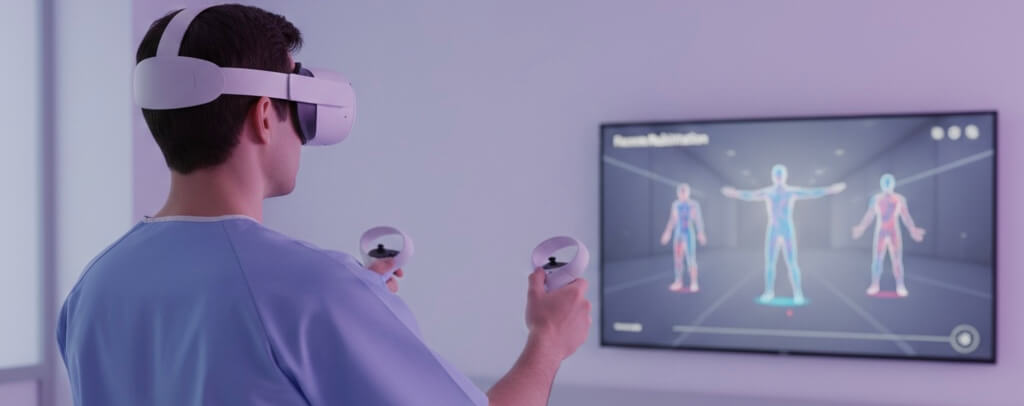
Virtual Reality rehabilitation systems use head-mounted displays, motion sensors, and interactive software to simulate real-world activities in a controlled digital environment [1]. These systems track patient movements and translate them into virtual actions, allowing therapists to monitor performance and progress in real time [1]. Virtual exercises are designed to target specific motor, cognitive, or sensory functions depending on the rehabilitation objective [2]. By adjusting difficulty levels and task complexity, Virtual Reality systems can match the patient’s physical and cognitive capabilities throughout the recovery process [2].
One of the key advantages of Virtual Reality rehabilitation is its ability to provide immediate visual and auditory feedback, which helps patients understand their movements and correct errors more effectively [1]. This feedback loop supports motor learning and reinforces correct movement patterns during therapy sessions [2]. Virtual Reality also enables repetitive task training in a way that feels engaging rather than repetitive, which improves patient motivation and consistency [1]. These features make Virtual Reality especially valuable in long-term rehabilitation programs where sustained engagement is critical for success [2].
Virtual Reality has demonstrated strong potential across multiple rehabilitation domains, including neurological, musculoskeletal, and cognitive therapy [1]. In neurological rehabilitation, Virtual Reality is commonly used for stroke recovery by supporting balance training, upper limb movement, and gait rehabilitation through simulated activities [2]. Patients recovering from stroke often benefit from Virtual Reality environments that encourage repetitive movement while reducing fear of falling or injury [2]. These virtual scenarios help patients practice functional tasks in a safe and controlled setting [1].
In musculoskeletal rehabilitation, Virtual Reality supports recovery from injuries and surgeries by guiding patients through structured movement exercises [1]. Virtual environments can replicate daily activities such as reaching, walking, or lifting, which helps patients rebuild strength and coordination relevant to real-life tasks [2]. By making exercises more interactive, Virtual Reality reduces perceived pain and discomfort during therapy sessions [1].
Cognitive rehabilitation also benefits from Virtual Reality through immersive scenarios that stimulate memory, attention, and problem-solving skills [2]. Patients with cognitive impairments can practice real-world activities such as navigation, task sequencing, and decision making within virtual environments [3]. These simulations provide a realistic yet controlled context that supports cognitive retraining while minimizing risk [3].
Virtual Reality offers measurable benefits for both patients and healthcare providers by improving engagement, efficiency, and therapy outcomes [1]. Patients often report higher motivation and enjoyment during Virtual Reality rehabilitation compared to conventional therapy methods [1]. Increased engagement leads to better adherence to therapy schedules and more consistent participation in rehabilitation programs [2]. This consistency plays a critical role in improving recovery outcomes over time [2].
For healthcare providers, Virtual Reality enables more precise tracking of patient progress through data-driven insights [3]. Motion tracking and performance metrics allow therapists to assess improvements objectively rather than relying solely on observational judgment [3]. Virtual Reality systems also support remote rehabilitation, allowing patients to continue therapy outside clinical settings under professional supervision [1]. This flexibility reduces the burden on healthcare facilities while expanding access to rehabilitation services [1].
From an operational perspective, Virtual Reality can help standardize therapy protocols and optimize therapist time by automating certain exercise routines [3]. This efficiency allows therapists to focus more on patient assessment and personalized care planning [3]. As healthcare systems face increasing demand and limited resources, Virtual Reality presents a scalable approach to delivering high-quality rehabilitation services [2].
Clinical research increasingly supports the effectiveness of VR in rehabilitation outcomes across diverse patient populations [2]. Studies indicate that Virtual Reality-based rehabilitation can produce comparable or improved results when compared to traditional therapy methods in areas such as balance, motor control, and functional mobility [2]. The immersive nature of Virtual Reality enhances neural engagement, which contributes to improved motor learning and neuroplasticity [2].
Emerging research also highlights the role of multisensory stimulation in Virtual Reality rehabilitation, which combines visual, auditory, and proprioceptive inputs to enhance learning outcomes [3]. These multisensory experiences help reinforce cognitive and motor pathways during recovery [3]. As hardware becomes more affordable and software more sophisticated, research continues to explore how Virtual Reality can be integrated into broader digital health ecosystems [1].
Virtual Reality is redefining rehabilitation by transforming therapy into an immersive, data-driven, and patient-centered experience [1]. By improving engagement, personalization, and accessibility, Virtual Reality enhances both clinical outcomes and operational efficiency within rehabilitation programs [2]. Clinical evidence continues to validate its effectiveness across neurological, musculoskeletal, and cognitive rehabilitation domains [2]. As technology evolves, Virtual Reality is positioned to become a core component of modern rehabilitation strategies that support long-term recovery and sustainable healthcare delivery [3].
Notes and References
- XRHealth. (2025). Enhancing Rehabilitation with Virtual Reality: A Comprehensive Guide - XRHealth. https://www.xr.health/us/blog/virtual-reality-rehabilitation/
- Naqvi, W., et. all (2024). The Dual Importance of Virtual Reality Usability in Rehabilitation: A Focus on Therapists and Patients - National Library of Medicine. https://pmc.ncbi.nlm.nih.gov/articles/PMC11032731/
- Capriotti, A. (2025). Virtual Reality: A New Frontier of Physical Rehabilitation - MDPI. https://www.mdpi.com/1424-8220/25/10/3080


