
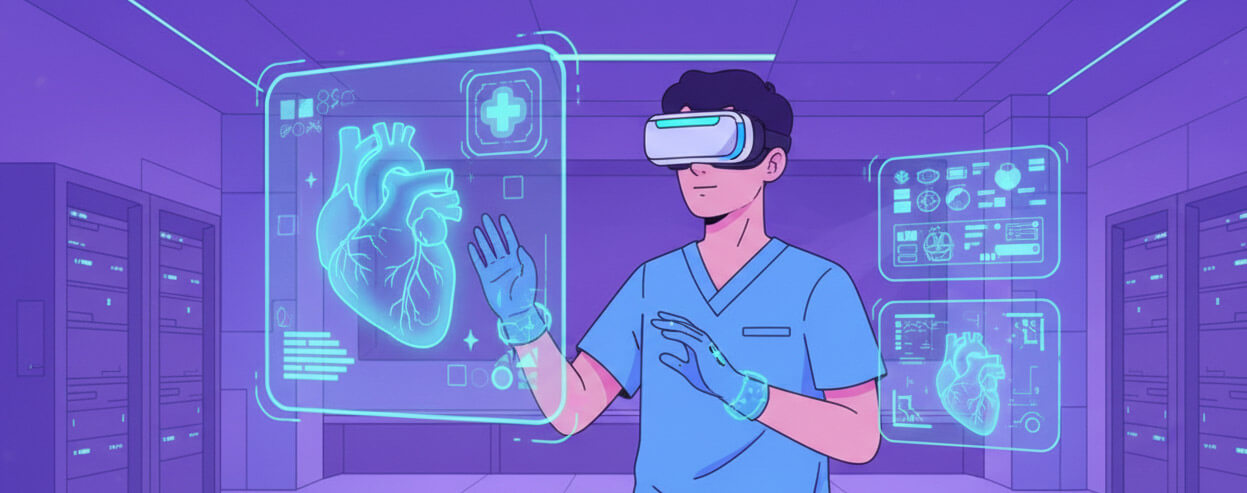
Virtual Reality’s Impact on Anatomy Learning
In the rapidly evolving world of medical education, one of the most traditional and essential courses remains human anatomy. Yet anatomy teaching faces persistent challenges: limited availability of cadavers, two-dimensional textbooks that struggle to convey 3D spatial relationships, and learners who must translate flat images into complex reality. Into this terrain enters virtual reality (VR), immersive, interactive and increasingly affordable, with the potential to revolutionize how anatomy is taught.
- What Virtual Reality Brings to Anatomy and Why It’s Growing
- The Role of VR in Anatomy Learning: Deeper Benefits and Operational Realities
- Spatial Understanding & Retention: One of the clearest advantages of VR is its ability to represent complex three-dimensional relationships; how bones, nerves, vessels and organs nest and interact. Unlike flat atlases or 2D projections, VR allows students to move around structures, slice them, zoom in, and toggle layers. This yields deeper spatial cognition, which is fundamental to anatomy [3].
- Engagement & Motivation: Students often report higher engagement when using VR. Because VR is interactive and immersive, it draws in learners in ways passive reading cannot. A focus-group study with medical students found that over 90% believed VR would enhance their anatomy learning and preferred having it offered [3]. When motivation and curiosity are higher, learning tends to follow.
- Accessibility & Scalability: VR enables institutions to provide anatomy experiences even when cadavers are scarce, or when physical labs are limited. For example, a recent study evaluated a VR anatomy simulation for 179 undergraduate medical students in Tunisia and found significant learning gains; importantly the VR platform was open source, cost-effective and scalable to resource-limited settings [2]. This suggests VR can help democratize anatomy teaching across geographies and institutions.
- Supplementation, Not Replacement (for now): It’s important to underscore that the current consensus is VR complements, rather than entirely replaces, traditional dissection or physical models. While many studies show positive outcomes with VR, heterogeneity in platform types, instructional integration and assessment tools means that VR’s ‘stand-alone’ efficacy is still being established. Some reviews caution that while VR performs well, designing the learning environment, aligning it with curriculum and training instructors remain critical [1].
- Operational Considerations & Integration: Implementation of VR in anatomy education involves more than buying headsets. Successful deployment requires careful selection of software, alignment with instructional goals, training of faculty, managing student workflow, and ensuring device usability and comfort (cybersickness is a non-zero concern). A systematic review of anatomy VR reported that while effects are promising, technical limitations, user onboarding, and study design variability remain barriers [1].
- Evidence Snapshot: What Research Shows
- A February 2025 systematic review synthesised 14 studies (961 participants) and found that 71% reported statistically significant improvement in anatomy learning outcomes with VR, including spatial understanding and knowledge retention [1].
- A June 2025 study in BMC Medical Education examined a VR-based anatomy simulation for 179 undergraduate medical students in Tunisia. The findings: VR significantly enhanced understanding of anatomical structures, reduced exam-anxiety, and offered a cost-effective, scalable option [2].
- A June 2024 article published in Scientific Reports compared six commercially available anatomy VR applications and evaluated functionality such as organ rotation, zooming, dissociation of layers, cross-sections and support for cadaver image-comparison. This work provided guidance on the suitability and features of VR tools in anatomy teaching [3].
- Conclusion
- Odogwu, T.S., et. all. (2025, April 8). Effect of Virtual Reality Simulation on Anatomy Learning Outcomes: A Systematic Review - Cureus. https://www.cureus.com/articles/356966-effect-of-virtual-reality-simulation-on-anatomy-learning-outcomes-a-systematic-review#!/
- Hammouda, S. B., et. all. (2025, Jun 1). The effectiveness of VR-based human anatomy simulation training for undergraduate medical students - BMC Medical Education. https://bmcmededuc.biomedcentral.com/articles/10.1186/s12909-025-07402-5
- Baek, S. W., et. all. (2024, Dec 30). Systematic analysis of anatomy virtual reality (VR) apps for advanced education and further applications - Scientific Reports. https://www.nature.com/articles/s41598-024-82945-z
Virtual reality refers to computer-generated environments that permit users to interact with three-dimensional models in immersive ways, often via headsets or other devices. In anatomy education, VR enables students to ‘walk around’ organs, rotate bones, explore layers of tissues, and visualize spatial relationships in ways that classic approaches cannot. Recent decade advances in processing power, 3D graphics, and headset affordability have driven VR’s growth in education broadly, and medical anatomy in particular.
When applied thoughtfully, VR holds a number of intersecting roles in anatomy learning, some pedagogical, some operational, and some strategic:
Recent empirical studies underscore how VR is making tangible differences in anatomy education:
Together these studies paint a picture of growing, albeit not yet uniform, evidence that VR supports anatomy learning, especially when integrated well into curricula, used as a supplement, and supported by faculty.
Virtual reality is no longer a futuristic novelty in anatomy education, it is a practical and increasingly powerful tool for transforming how medical learners engage with human structure and form. By delivering immersive, interactive, scalable experiences, VR enhances spatial understanding, boosts engagement, and opens anatomy learning to a wider audience. While it does not yet replace traditional dissection and physical models, the evidence suggests VR is a highly effective adjunct that blends the best of technology and pedagogy. As medical education evolves, institutions that embrace VR thoughtfully, aligned with curriculum, resourced for integration, and evaluated for outcomes, stand to equip their students with deeper anatomical insight and readiness for clinical practice. The body of human knowledge remains unchanged, but how we teach it is evolving, and virtual reality is at the forefront of that change.


