
What Is Google TPU and Why It Matters for the Future of AI
- Introduction: Understanding Google’s AI Chip TPU
- What Is a TPU and Why Google Built It
- How TPUs Power Google’s AI Ecosystem
- TPUs Versus GPUs and the AI Hardware Competition
- Why TPUs Matter for the Future of AI
- Conclusion
As artificial intelligence continues to scale across industries, specialized hardware has become critical to delivering faster, more efficient, and more reliable AI performance at scale [1]. Google’s Tensor Processing Unit, commonly known as TPU, is a custom-built AI chip designed specifically to accelerate machine learning workloads within Google’s infrastructure [1]. Unlike general-purpose processors, TPUs are optimized to handle the mathematical operations that power modern AI models, particularly deep learning systems used in products like Search, YouTube, and Gemini [3]. This strategic move toward in-house AI hardware reflects Google’s long-term vision to control both software and infrastructure in the rapidly evolving AI landscape [3].
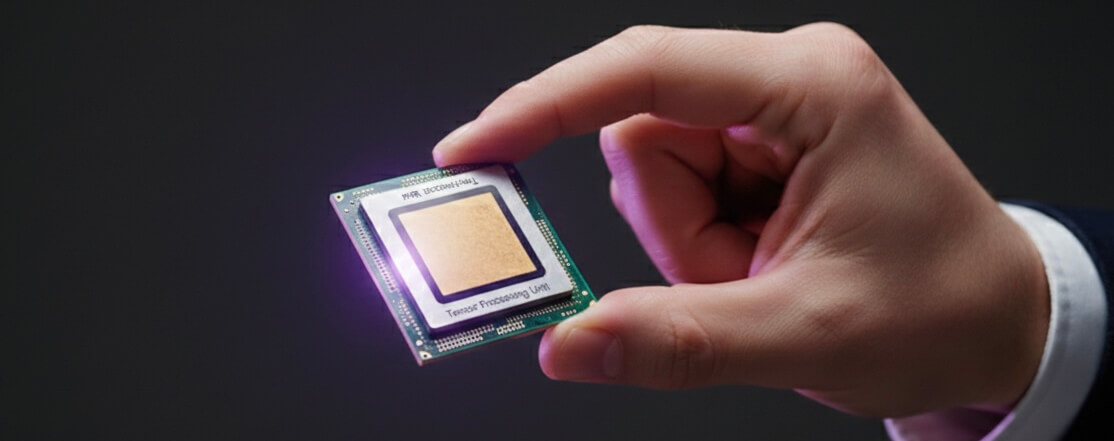
A Tensor Processing Unit is a custom application-specific integrated circuit developed by Google to accelerate neural network computations [4]. TPUs are designed to efficiently process large volumes of matrix multiplications, which are the core operations behind training and running machine learning models [4]. Google began developing TPUs to overcome the cost, energy, and scalability limitations associated with relying solely on traditional CPUs and GPUs for AI workloads [1]. By building its own AI chips, Google gained the ability to tailor hardware performance directly to its AI software frameworks such as TensorFlow [2].
This tight integration allows Google to optimize latency, throughput, and power efficiency in ways that off-the-shelf hardware cannot easily achieve [2]. Over time, TPUs have evolved from inference-focused chips to full-stack accelerators capable of handling both training and deployment of large AI models [1]. This evolution has positioned TPUs as a foundational component of Google’s AI infrastructure strategy [3].
TPUs are deeply embedded across Google’s cloud and internal systems, enabling large-scale AI processing for consumer and enterprise applications [1]. They are used to support services such as Google Search ranking, language translation, recommendation systems, and generative AI models like Gemini [3]. By leveraging TPUs, Google can process massive datasets more efficiently while reducing energy consumption per computation [2].
In Google Cloud, TPUs are offered as a service to businesses that require high-performance AI infrastructure without managing physical hardware [1]. This allows organizations to train and deploy machine learning models faster while benefiting from Google’s optimized AI stack [1]. The availability of TPUs through Google Cloud also positions Google as a competitor to GPU-centric cloud providers in the AI infrastructure market [4].
While GPUs remain the dominant choice for many AI workloads, TPUs offer a specialized alternative designed around Google’s specific AI needs [4]. GPUs are versatile and widely supported, but they are not purpose-built solely for machine learning operations [4]. TPUs prioritize efficiency and performance for AI tasks by eliminating unnecessary functions that general-purpose chips must support [2].
This specialization allows TPUs to deliver strong performance per watt, which is increasingly important as AI models grow in size and complexity [2]. Google’s reliance on TPUs also reduces dependency on external chip suppliers such as NVIDIA, which has significant implications for the broader semiconductor industry [3]. As more companies explore custom silicon, Google’s TPU strategy highlights a shift toward vertical integration in AI development [3].
Google’s investment in TPUs signals a broader industry trend toward custom AI hardware as a competitive advantage [4]. Control over AI chips enables faster innovation cycles, better cost management, and tighter integration between models and infrastructure [3]. As AI systems become more complex and compute-intensive, specialized hardware like TPUs will play a growing role in determining which companies can scale effectively [4].
For enterprises adopting AI, Google’s TPU-backed cloud services offer an alternative path to deploying high-performance AI solutions without building proprietary infrastructure [1]. This lowers the barrier to entry for advanced AI capabilities while giving businesses access to hardware optimized for modern machine learning workloads [1].
TPUs are also valuable for applications that require real-time responses, such as search queries, voice assistants, and personalized content recommendations [3]. By optimizing inference performance, Google can scale AI-powered services to billions of users without proportional increases in infrastructure costs [1]. This capability strengthens Google’s ability to deliver consistent AI experiences across its global platforms [1].
Google’s Tensor Processing Units represent more than just a technical achievement, as they are a strategic pillar of the company’s AI ecosystem [3]. By designing chips tailored specifically for AI workloads, Google has gained greater control over performance, cost, and scalability across its products and services [2]. TPUs enable Google to compete more effectively in both consumer AI applications and enterprise cloud services while reducing reliance on third-party hardware providers [4].
As the AI industry continues to evolve, Google’s TPU strategy demonstrates how custom hardware can shape the future of artificial intelligence deployment at scale [3]. For business leaders and technology decision makers, understanding TPUs provides valuable insight into how AI infrastructure choices influence performance, efficiency, and long-term innovation [1].
Notes and References
- Langley, H. (2025). What are TPUs? Everything You Need To Know About Google's Market-Moving AI Chips - Business Insider. https://www.businessinsider.com/google-tpu-ai-chip-explained-nvidia-2025-12
- Jason. (2025). Google TPU: The AI Chip for the AI Inference Era - Naddod. https://www.naddod.com/ai-insights/google-tpu-the-ai-chip-for-the-ai-inference-era?srsltid=AfmBOooe7X8gPPri-8FquesDRNOBYR_YJ4rQKbfLO7bd3qTbPs_PSRB-
- Mohasseb, A. (2025). Google Is Relying On Its Own Chips For Its AI System Gemini. Here’S Why That’S a Seismic Change For The Industry - The Conversation. https://theconversation.com/google-is-relying-on-its-own-chips-for-its-ai-system-gemini-heres-why-thats-a-seismic-change-for-the-industry-270818
- Wilkins, A. (2025). Why Google’s Custom AI Chips Are Shaking Up The Tech Industry - New Scientist. https://www.newscientist.com/article/2506354-why-googles-custom-ai-chips-are-shaking-up-the-tech-industry//


